
A previously unseen network of cells plays a critical role in helping hair emerge from the roots, according to a study that may rewrite textbooks and lead to new hairfall treatments.
Until now, it was thought that the human hair emerged due to an upward push from the root.
However, the new study used advanced 3D imaging to reveal that each hair was pulled upward by a coordinated network of moving cells.
“For decades, it was assumed that hair was pushed out by the dividing cells in the hair bulb,” said Inês Sequeira from Queen Mary University of London.
“We found that instead that it’s actively being pulled upwards by surrounding tissue acting almost like a tiny motor,” said Dr Sequeira, an author of the study published in the journal Nature Communications.
In the study, scientists blocked cell division inside the hair follicle and expected hair growth to slow or stop. Instead, they saw that growth continued at nearly the same rate.
But when they disrupted the protein actin, which allows cells to contract and move, they found that hair growth fell by more than 80 per cent.
Computer simulations confirmed that the pulling force of the actin protein, linked to coordinated movement in the follicle’s outer layers, was key to the observed speed of hair movement upwards.
“This approach reveals a spiral-like downward movement of outer root sheath cells entering the lower bulb region,” the study noted.
“We propose a mechanistic model, where a pulling force induced by the outer root sheath contributes to hair fibre extrusion.”
Using advanced 3D time-lapse microscopy in real time, researchers could peer into the intricate, dynamic biological processes within the hair follicle.
The technique enabled them to observe cell divisions otherwise impossible to deduce from discrete observations.
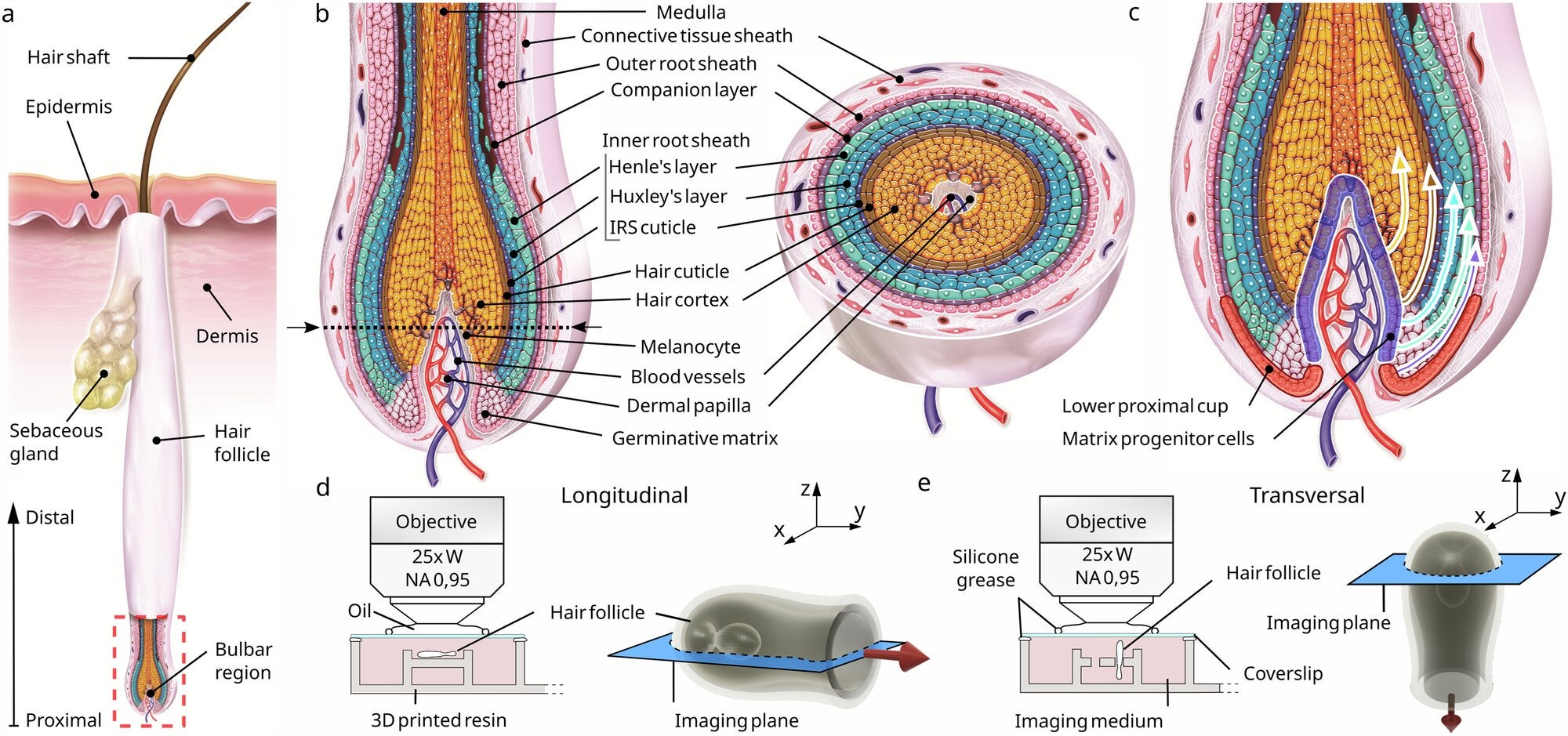
“This approach made it possible to model the forces generated locally,” said Nicolas Tissot, another author of the study.
The observations revealed that hair growth was not driven by cell division alone but the outer root sheath “actively pulls the hair upwards”, said Thomas Bornschlögl, another of the study’s authors.
Researchers hope this new understanding of the mechanical forces behind hair growth can help design hairfall treatments targeting the follicles.
“This new view of follicle mechanics opens fresh opportunities for studying hair disorders, testing drugs, and advancing tissue engineering and regenerative medicine,” Dr Bornschlögl said.
The imaging method used in the study can also allow live testing of different drugs and treatments, scientists say.
#Groundbreaking #study #rewrite #textbooks #hair #grows #spark #treatments